
AMS Restoration Inc. — Serving Claremont, CA
Water Damage Restoration in Claremont, CA
Complete water cleanup, extraction, drying, and restoration coordination
Water damage restoration is the process of assessing, removing, drying, and restoring a property after water intrusion from plumbing leaks, burst pipes, appliance failures, roof leaks, or storm-related water entry. AMS Restoration Inc. provides water damage restoration for Claremont homes and businesses, helping property owners move from damage toward recovery.
Water losses in the Claremont area come from many sources: burst pipes and plumbing leaks, overflowing fixtures, appliance leaks, water heater failures, toilet overflows, HVAC condensate problems, fire sprinkler discharge, storm-related intrusion, and hidden water damage that has soaked into building materials before it is noticed. Each source leaves a different moisture pattern, but all require evaluation, removal, and drying.
If you have discovered water damage, call (909) 993-3428. Related services include emergency water extraction, flood damage cleanup, burst pipe cleanup, structural drying, and commercial restoration.
Water Damage Problems We Restore Near Claremont
Water moves through building materials in ways that are not always visible. When water sits against drywall, it wicks upward into the core and spreads laterally behind the surface. It travels under flooring into the subfloor, soaks into baseboards and trim, enters wall cavities through gaps and seams, and settles against framing and insulation. Visible water on the floor is often only a fraction of the moisture present in the structure.
This is why a small leak can create a large problem. A slow plumbing leak inside a wall can saturate insulation and framing over days or weeks before any stain appears. A burst pipe can flood a room in minutes, sending water under baseboards and into adjacent spaces. Understanding how water migrates is the first step in restoring it properly.
Drywall, insulation, subfloor, flooring, baseboards, cabinetry, ceilings, and wall cavities are the materials most often affected by water damage. Each holds moisture differently and dries at a different rate. Drywall wicks water into its core, insulation traps it against framing, and subflooring holds it between layers — meaning the surface can look dry while the structure is still wet.
Because water can travel beyond the visible wet area, a proper assessment checks adjacent rooms, the level below, behind cabinets, and inside wall cavities. Assuming the damage is limited to where the water was seen is one of the most common reasons secondary damage develops after a loss.
Common Signs of Hidden Water Damage
- Discolored or darkened patches on ceilings and walls
- Soft, swollen, or crumbling drywall and baseboards
- A persistent musty or damp odor in a room
- Warped, buckling, or lifting flooring and trim
- Moisture readings above the expected baseline
- Unexplained increase in indoor humidity
How Water Damage Restoration Works in Claremont
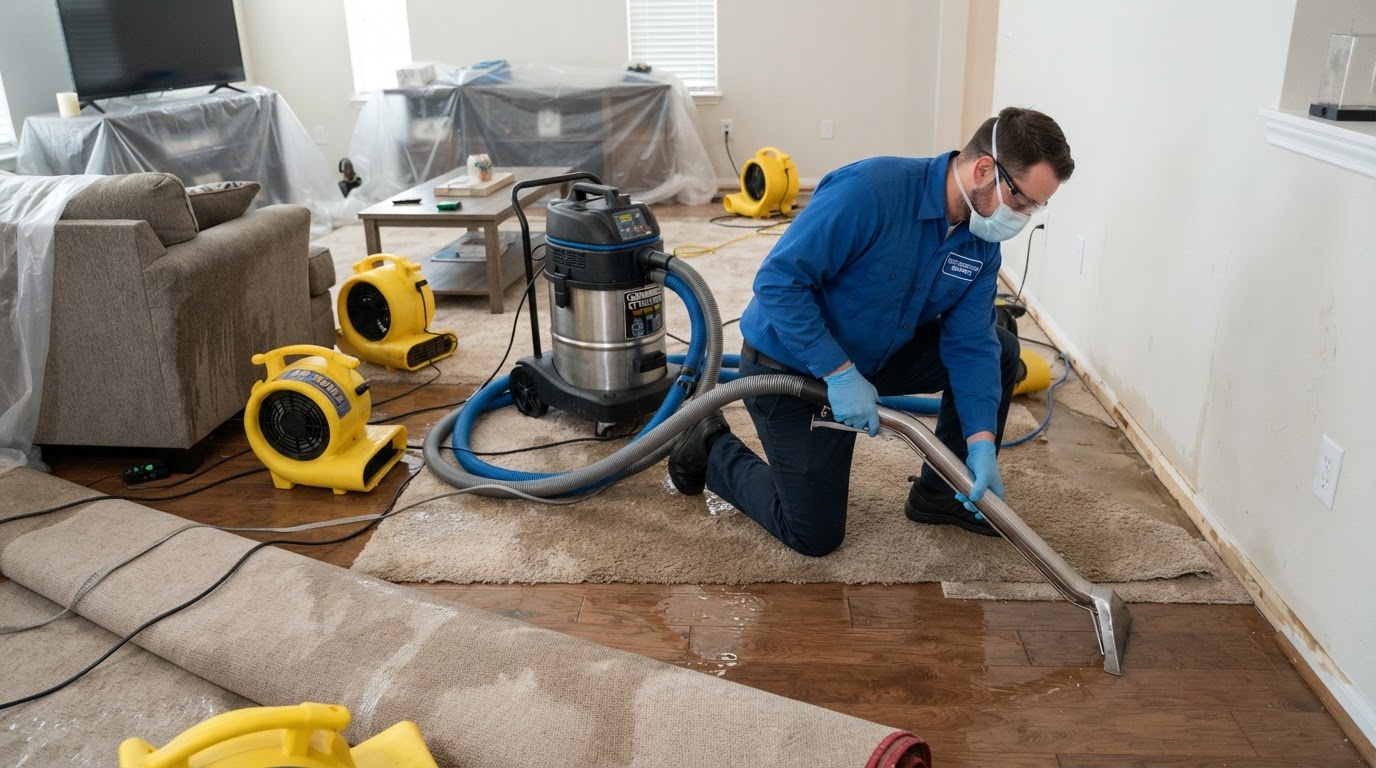
Water damage restoration follows a sequence that begins with assessment and continues through drying, cleaning, and restoration coordination. The process is adapted to the source, the materials affected, and the contamination category of the water.
- 1
Damage Assessment
We evaluate the source, the affected areas, and how far moisture has migrated — including into adjacent rooms, the level below, and concealed cavities.
- 2
Water Removal
Standing water is extracted when present using professional extraction equipment to reduce the volume the materials have absorbed.
- 3
Moisture Detection
Moisture meters map wet materials, including inside wall cavities and under flooring, establishing a baseline for drying.
- 4
Drying Strategy
A drying plan is built based on the affected materials, the extent of saturation, and the conditions in the space.
- 5
Air Movement & Dehumidification
Air movers and dehumidifiers are positioned to promote evaporation and capture moisture from the air so it does not reabsorb.
- 6
Monitoring & Restoration Coordination
Readings are taken over time and equipment adjusted. Once materials reach an appropriate dry standard, restoration and repair work is coordinated.
What happens during professional water damage cleanup?
Professional water damage cleanup includes assessing the source and affected areas, extracting standing water, detecting moisture in concealed cavities, setting up drying equipment, dehumidifying the air, monitoring readings over time, and coordinating cleaning and restoration. The goal is to reduce excess moisture in affected materials and prepare the property for repairs.
What Materials Can Be Affected by Water Damage?
Water damage affects a range of property types and building materials. The scenarios below show how the same restoration principles apply across homes, multi-family buildings, and commercial spaces.
Homes
Single-family residences where plumbing leaks, appliance failures, and roof intrusion affect drywall, flooring, and cavities.
Condos & Apartments
Multi-unit properties where water can cross shared walls, ceilings, and floors into adjacent units.
Commercial & Retail
Offices, retail stores, and restaurants where larger floor areas, inventory, and operations add complexity.
Drywall & Ceilings
Drywall wicks water into its core; ceilings absorb leaks from above and can sag or weaken.
Flooring & Subfloor
Carpet, padding, hard flooring, and subflooring all hold moisture and may require drying or removal.
Cabinetry & Walls
Cabinet bases trap water against the floor, and wall cavities conceal moisture behind the surface.
The affected materials determine the drying approach and whether any require removal. Contaminated water, severely saturated materials, or structurally compromised components may need to be removed rather than dried. The decision is based on the contamination category, the material condition, and moisture readings.
For specific scenarios, see our pages on water extraction, flood damage cleanup, burst pipe cleanup, and structural drying. Commercial losses are covered under commercial restoration.
Why Claremont Property Owners Call AMS Restoration Inc.
AMS Restoration Inc. serves Claremont and surrounding communities with a focus on complete water damage restoration — not just removing visible water. We assess where moisture has migrated, extract what is present, and dry the materials that have absorbed it, monitoring readings until they reach an appropriate dry standard.
We do not claim to be the fastest, the best, or the highest-rated, because those are claims we cannot verify. What we offer is an organized restoration process, clear communication, and a service footprint that covers Claremont and nearby communities. Documenting affected areas and restoration work may help property owners organize information associated with an insurance claim.
From a single-room plumbing leak to a multi-area commercial loss, the same principles apply: assess, remove, detect, dry, monitor, and coordinate. Restoring homes, moving hearts.
Water Damage Restoration FAQs for Claremont Property Owners
Need Water Damage Restoration in Claremont?
Water can migrate beyond the visible wet area into drywall, flooring, and wall cavities, and the longer it sits the more it soaks in. Call AMS Restoration Inc. at (909) 993-3428 to discuss your situation, or request restoration service and a team member will reach out. Assessment and extraction are the first steps toward recovery.